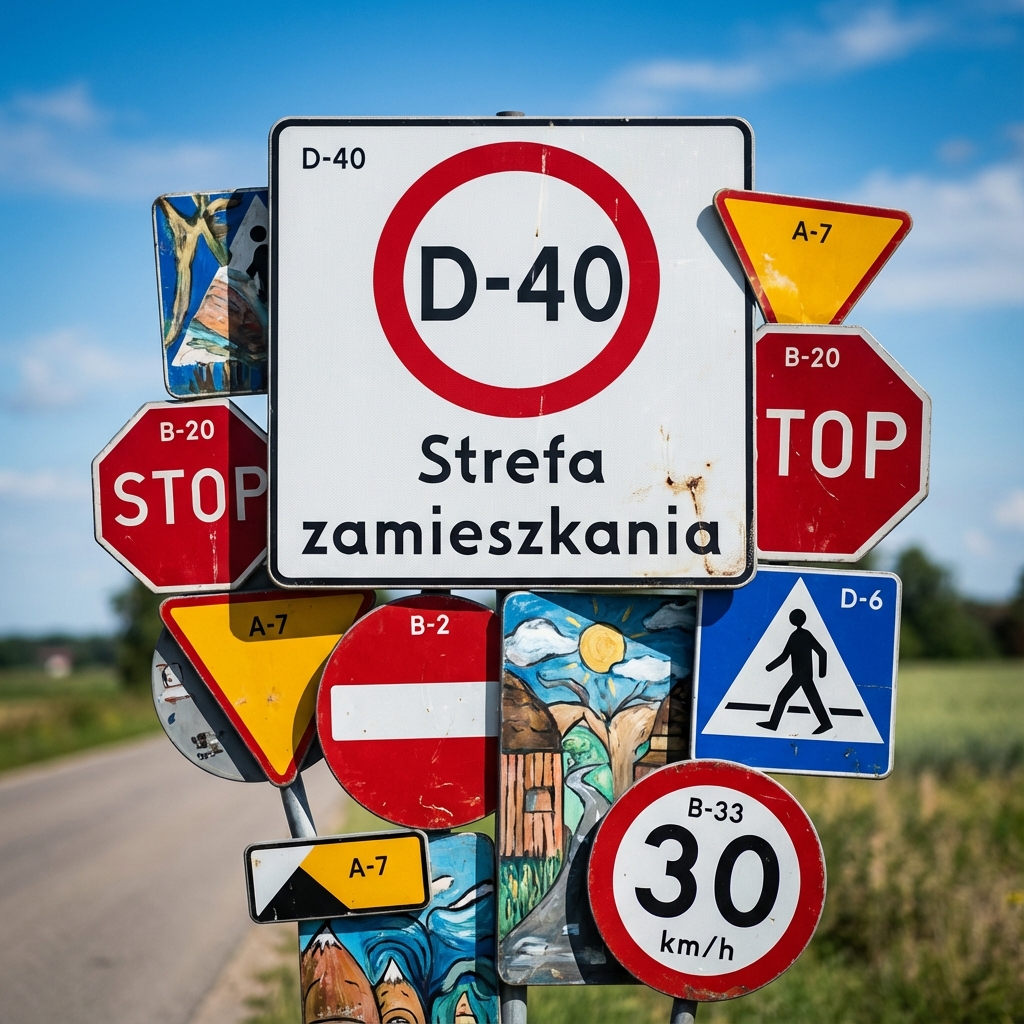
Polish road signs: warning, prohibition, mandatory, information, direction, supplementary signs and road markings, with rules, examples and exam questions.
Road signs are the biggest single topic on the Polish theory exam — and knowledge you'll use on every kilometre you drive. One thing worth knowing for expats: Polish signs largely follow the Vienna Convention, so much will look familiar — but yellow-background warning triangles and a few uniquely Polish rules trip up drivers from other countries. Below is a systematic overview of every group, with the rules that appear most often in exam questions.
Map of the sign groups
As of: September 2026.
Group A: warning signs
Triangular, with a red border. They say one thing: slow down and be ready. Exam classics:
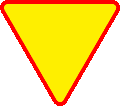
- A-7 "give way" — the only triangle "inverted" with the point facing down; it applies at the nearest junction.
- A-6a–c — junctions with a minor road: YOU have priority, but stay alert.
- A-9/A-10 — railway crossings with and without barriers; a frequent theme in questions about behaviour at level crossings.
Exam trap: outside built-up areas a warning sign is placed 150–300 m before the hazard; in built-up areas — up to 100 m.
Group B: prohibition signs
Round with a red border. They apply from where they stand — usually until the nearest junction or a cancelling sign.

- B-20 "stop" — a mandatory full stop before the line; the only octagonal sign in Poland.
- B-33 — speed limit; cancelled by B-34, the end of a zone, or a junction.
- B-1/B-2 — no traffic in both directions / no entry (the "brick", as Poles call it).
- B-25/B-26 — no overtaking; practise with the overtaking category.
Group C: mandatory signs
Round and blue — they indicate a compulsory direction or manner of driving.

- C-12 "roundabout" — combined with A-7 it determines priority on a roundabout (a classic exam topic — roundabout rules and indicator use are worth studying carefully).
- C-2–C-8 — compulsory directions of travel at a junction.
Blue rectangles. They inform — but often also establish rules:
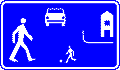
- D-40 "residential zone" — pedestrians have priority across the full width of the road, a 20 km/h limit, and parking only in designated spots. One of the most commonly confused signs — we cover it in more depth in confusing traffic signs.
- D-42/D-43 — built-up area (50 km/h limit) and its end.
- D-1 — priority road.

Groups E and F: direction and supplements
Direction boards (E) guide you to towns and facilities — green on motorways and expressways, blue on other roads (more in our guide to motorway driving). Supplementary signs (F) clarify traffic organisation, such as how to use the lanes.
Road markings (P)
Broken and solid lines, arrows, triangles and text on the carriageway. Key rules: you must not touch or cross a solid line, a triangle painted on the road repeats the A-7 give way sign, and directional arrows in a lane oblige you to travel in the indicated direction. The full category: road markings.
Plates (T): the fine print below the sign
A plate below a sign can completely change its scope — for example, indicating that a prohibition doesn't apply to residents, or stating the distance to the hazard. On the exam, always read a sign together with its plate.
How to learn all this (without rote memorisation)
- Learn by group, not sign by sign — shape and colour tell you 80% of the meaning before you even look at the symbol.
- Work through questions by category — start with warning signs, then prohibition and mandatory signs.
- Test yourself against the clock — in the mock exam the sign questions look exactly like they do at the WORD exam centre (where, incidentally, you can take the theory exam in English).
- Keep the database with you — all 3,518 official questions (including every sign in the pool) are in the Prawo Jazdy GO app for iOS and Android.
Frequently asked questions (FAQ)
How many groups of road signs are there?
Vertical: warning (A), prohibition (B), mandatory (C), information (D), direction (E), supplementary (F) plus plates (T) — and road markings on the carriageway.
Which sign is octagonal?
B-20 "stop" — the only one; recognisable even when covered in snow.
How far does a prohibition sign apply?
As a rule, until the nearest junction or until a cancelling sign.
What does a triangle with the point facing down mean?
A-7 "give way" — the only warning sign with that orientation.
Sources
- Regulation on road signs and signals (division into groups A–T and P)
- Official exam question database (examples of signs in questions)
As of: September 2026.
Frequently asked questions
What are the groups of road signs in Poland?
Vertical signs are divided into: warning (A), prohibition (B), mandatory (C), information (D), direction and locality (E), supplementary (F), plus additional signs before railway crossings (G) and small plates (T). Road markings painted on the carriageway (P) form a separate group.
How do you recognise a warning sign?
Warning signs (group A) are triangular with a red border and a yellow background. They warn of danger — such as a bend, a railway crossing or animals on the road — and require particular caution.
What is the difference between a prohibition sign and a mandatory sign?
Prohibition signs (group B) are round with a red border and tell you what you must not do (e.g. B-20 "stop", B-33 speed limit). Mandatory signs (group C) are round and blue — they tell you what you must do (e.g. C-12 roundabout, driving in a specified direction).
How many road sign questions are on the exam?
There is no fixed number — questions are drawn from the whole database, but road signs are one of the most heavily represented topics in the official question pool, so confidently recognising every group of signs is the foundation of a passed theory exam.