The Polish Driving Exam Explained (2026): Theory and Practical, Step by Step
Polish category B driving exam in 2026: 32 questions in 25 minutes, a 68/74 pass mark, manoeuvring area tasks and city driving. A guide for foreigners.

Filip Kowalski
Prawo Jazdy GO team — the app with the full official database of 3,518 exam questions
The Polish state driving exam has two parts: the theory test (a computer exam at WORD — Wojewódzki Ośrodek Ruchu Drogowego, the regional exam center) and the practical exam (manoeuvring area + city driving). Good news for expats: the theory exam is officially available in English — you choose the language when booking. This guide walks through both parts exactly as they work in 2026.
The theory exam in a nutshell
| Element | Value |
|---|---|
| Number of questions | 32 |
| Time | max. 25 minutes |
| General part | 20 YES/NO questions (video clips and photos of real traffic situations) |
| Specialist part | 12 A/B/C questions (for your category) |
| Maximum points | 74 |
| Pass mark | 68 points |
| Going back to a question | not possible after confirming |
As of: July 2026.
Questions carry different weights — 3, 2 or 1 point, depending on how important they are for road safety. That means the margin for error is very small: two mistakes on "expensive" questions are enough to fail. We break down the exact point distribution in a separate article on theory exam scoring.
In the general part you get 20 seconds to read the question and 15 seconds to answer; in the specialist part — 50 seconds per question. No answer counts the same as a wrong answer.
How to prepare: the exam questions come from a public, official database — there are no surprises. Work through them systematically — you'll find all of them on our site organized by topic, e.g. warning signs, prohibition and mandatory signs or junctions with priority signs — and before the real exam, take a few online mock exams under conditions identical to those at WORD.
The practical exam: two parts
The practical exam is conducted in Polish. If your Polish is limited, you're allowed to bring an interpreter (a sworn translator) at your own expense — but in practice the examiner's instructions are simple and repetitive ("proszę skręcić w prawo" — please turn right), and many candidates manage after learning a handful of phrases with their instructor. In bigger cities you can also find driving schools with English-speaking instructors who prepare you for exactly this.
Part 1: The manoeuvring area (plac manewrowy)
On the manoeuvring area the examiner assesses:
- Preparing to drive — adjusting the seat, mirrors and headrest, fastening the seatbelt. Do it demonstratively, even if everything is already set.
- Vehicle checks (czynności kontrolno-obsługowe) — the examiner randomly asks you to, for example, check the oil or brake fluid level, or point out specific lights.
- Driving forward and in reverse along a marked lane (the "łuk", or arc) — driving through a marked lane without touching the lines or cones.
- Hill start — moving off on an incline without rolling back or stalling the engine.
A detailed walkthrough of every task (with the most common mistakes) is in our guide to the manoeuvring area tasks.
Warning: performing the same task incorrectly twice means a negative result — and mistakes on the arc are statistically one of the most common reasons for failing the exam.
Part 2: Driving in traffic
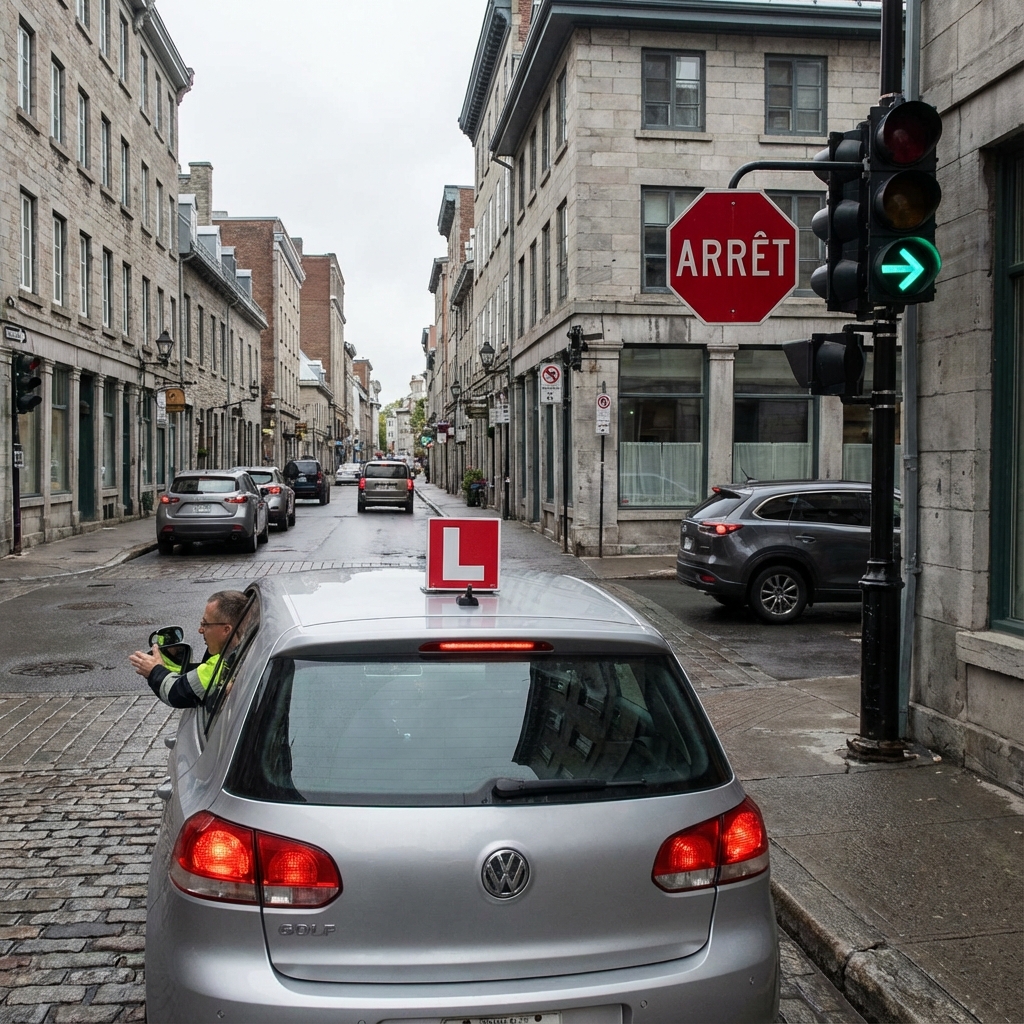
The city portion lasts at least 40 minutes (the examiner may end the exam after 25 minutes if all mandatory tasks have been completed successfully). The route will include, among other things: driving through junctions (unmarked, with traffic lights, roundabouts), changing lanes, merging into traffic, parking and making a U-turn.
The examiner stops the exam immediately if you create a hazard — classic examples are failing to yield right of way, running a red light, or not giving way to a pedestrian. It's worth reviewing the topics behaviour towards pedestrians and junctions with traffic lights not just for the theory test, but for the practical too.
What exam day looks like
- Arrive 15–20 minutes early with your ID (passport or residence card works).
- Your details are verified and you're called to the exam room (theory) or the manoeuvring area (practical).
- Theory: you see your result immediately after finishing the test.
- Practical: you get the result and a debrief of any mistakes from the examiner right after the drive.
- After passing both parts, WORD forwards the result to the transport department (wydział komunikacji) — that's where you apply for the physical license (all fees are broken down in our driving license cost guide).
What changed in 2026
- Category B from age 17 — from 3 March 2026, with written parental consent; until the 18th birthday, driving only with a mentor passenger (aged 25+, license held 5+ years), and only within Poland.
- Higher exam fees — from 1 January 2026, set by regional (voivodeship) assemblies (theory approx. 55–65 PLN, category B practical approx. 222–250 PLN); the first increase in 12 years.
- Probation period — 3 years for the youngest drivers, with a zero-alcohol limit and a 12-penalty-point cap.
Frequently asked questions (FAQ)
How long does the theory exam take? A maximum of 25 minutes for 32 questions. Most people finish early.
Can I go back to a previous question? No. Once you confirm an answer (or time runs out), the question disappears and cannot be corrected.
How many points do I need to pass the theory? 68 out of a possible 74 points.
Can I take the practical exam in my driving school's car? Yes — you may take the exam in the OSK (driving school) vehicle you trained in (the school usually charges a fee for bringing the car to the exam center).
When do I get my result? Theory: instantly on screen. Practical: directly after the drive, from the examiner.
Sources
- Official rules of the theory part of the state exam (32 questions, 25 minutes, 68/74 pass mark) — WORD Warszawa
- WORD announcements on exam fees from 1.01.2026
- Amendment to the Act on Vehicle Drivers (category B from 17, probation period) — in force since 3.03.2026
As of: July 2026.
Frequently asked questions
What does the Polish theory exam look like in 2026?
The theory exam is a computer test of 32 single-choice questions with a maximum of 25 minutes: 20 general-knowledge questions (video clips and photos, YES/NO answers) and 12 specialist questions for your license category (answers A/B/C). You need 68 out of 74 points to pass. Once you confirm an answer, you cannot go back to the question. The exam is officially available in English.
What does the category B practical exam look like?
The practical exam consists of tasks on the manoeuvring area (preparing to drive, vehicle checks, driving forward and in reverse along a marked lane — the 'łuk' or arc, and a hill start) followed by driving in real traffic, which lasts at least 40 minutes (the examiner may end it after 25 minutes if all tasks have been completed correctly).
What can fail you on the practical exam?
The exam ends with a negative result if you perform the same task incorrectly twice, and immediately if you create a safety hazard (e.g. failing to yield right of way, running a red light). The most common reasons for failing are mistakes on the arc ('łuk') and failing to yield.
Can you take the exam before turning 18 in 2026?
Yes. From 3 March 2026, 17-year-olds can take the category B course and exam with written consent from a parent or legal guardian. Until they turn 18, they may only drive accompanied by a mentor passenger (min. 25 years old, holding a category B license for at least 5 years).
Related articles
Polish Theory Exam Scoring 2026 — How Many Points Do You Need to Pass?
You need 68 of 74 points to pass Poland's theory exam. How 3-, 2- and 1-point questions count, how many mistakes you can make and how to score your test.
Manoeuvring Area Tasks 2026 — Every Category B Exam Task Explained
Polish driving exam manoeuvring area: preparation, the arc (łuk) and hill start, with assessment criteria and mistakes that cause candidates to fail.
How Much Does a Polish Driving License Cost in 2026? Full Category B Price Breakdown
Polish category B license costs in 2026: course, medical exam and admin fees, plus the first state exam fee increase in 12 years.
Most common mistakes on the practical exam – TOP 10 traps
Why do students fail the driving test? Learn the 10 most common mistakes (right of way, green arrow, parking) and how to avoid them.