
Unofficial translation for learning purposes. Only the Polish text published in Dziennik Ustaw is legally binding — open the Polish original. Source: Regulation of 31 July 2002 on road signs and signals (Dz. U. 2019 poz. 2310, as amended).
§ 95.

1) green signal - permission to drive past the traffic light;
2) yellow signal - no driving past the traffic light, unless at the moment this signal comes on the vehicle is so close to the traffic light that it cannot be stopped in front of it without harsh braking; this signal also means that the red signal is about to come on;
3) red signal - no driving past the traffic light;
4) red and yellow signals given at the same time - no driving past the traffic light; these signals also mean that the green signal is about to come on.
2. The green signal does not permit driving past the traffic light if:
1) the movement of the vehicle would obstruct pedestrians or cyclists in leaving the carriageway;
2) because of the traffic conditions at the intersection or beyond it, leaving the intersection would not be possible before the green signal ends.
3. A traffic light used outside an intersection to control traffic on a narrowed section of road may give signals in two colours - green and red.

§ 95a.
1. The light signals given by traffic light S-1a concern cyclists who are on the part of the road intended only for bicycle traffic or who are entering that part of the road.
2. The provisions of § 95 para. 1 and 2 apply accordingly to the signals given by traffic light S-1a.
§ 96.
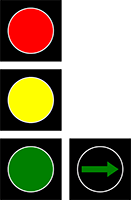
1. The red signal given by traffic light S-2 together with a signal in the shape of a green arrow means that turning in the direction indicated by the arrow into the nearest carriageway at the intersection is permitted, subject to para. 3.

2. A signal in the shape of a green arrow, given by traffic light S-2, which permits turning left also permits making a U-turn from the extreme left-hand traffic lane, unless this is prohibited by sign B-23.
3. The turning or U-turn referred to in para. 1 and 2 is permitted provided that the driver stops in front of the traffic light and does not obstruct other road users.
§ 97.

1. The light signals given by directional traffic light S-3 concern drivers travelling in the directions indicated by the arrow (arrows).
2. The provisions of § 95 para. 1 and 2 apply accordingly to the signals given by directional traffic light S-3.
3. A green signal given by directional traffic light S-3 means that travelling in the indicated direction involves no conflict with other road users.
4. Directional traffic lights S-3 giving signals intended only for vehicles turning left need not be placed on the right-hand side of the road.
§ 97a.
1. The light signals given by traffic light S-3a concern cyclists who are on the part of the road intended only for bicycle traffic or who are entering that part of the road, travelling in the directions indicated by the arrow (arrows).
2. The provisions of § 95 para. 1 and 2 and of § 97 para. 1, 3 and 4 apply accordingly to the signals given by directional traffic light S-3a.
§ 98.

1) green signal - permission to enter the traffic lane above which the traffic light is placed;
2) red signal - no entry into the traffic lane above which the traffic light is placed.
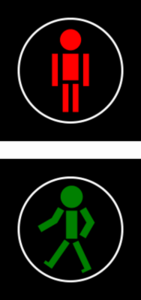
1) green signal - permission to step onto the pedestrian crossing, whereby a flashing green signal means that the red signal is about to come on and the pedestrian is obliged to leave the crossing as quickly as possible;
2) red signal - no stepping onto the crossing.

1) green signal - permission to enter the cycle crossing, whereby a flashing green signal means that the red signal is about to come on and the cyclist is obliged to leave the crossing as quickly as possible;
2) red signal - no entry onto the crossing.

4. A steady or flashing light signal given by traffic light S-7 means an obligation to leave the traffic lane above which the traffic light is placed and to move onto the part of the carriageway on the side indicated by the arrow.
5. A flashing red signal, or two alternately flashing red signals, mean no driving past the traffic light or other device giving those signals.
6. A flashing or steady yellow signal placed on an obstacle, or a flashing yellow signal given by a traffic light, warn of a danger or an obstruction to traffic that is present and require particular care.
§ 99.
1. Stopping a vehicle as required by the signal given should take place before the stop line or, in the absence of such a line, before the traffic light.
2. If the traffic light is placed above the carriageway, stopping a vehicle as required by the signal given should take place before the stop line or, in the absence of such a line, before the carriageway above which the traffic light has been placed.
§ 100.
The light signals referred to in § 95-97 and § 98 para. 1, 4 and 5 also concern columns of pedestrians, riders and drovers.
§ 101.
A light signal in the form of white digits on a board or on a traffic light means entry onto a section of carriageway on which travelling at the speed expressed in kilometres per hour is recommended. Light signals for drivers of vehicles carrying passengers for payment on regular services
§ 102.
1. The light signals for drivers of buses and other vehicles carrying passengers for payment on regular services, travelling in the traffic lanes designated for them, are white.
2. The light signals referred to in para. 1, given by traffic light SB, mean:
1) a signal in the shape of a vertical bar - permission to drive past the traffic light;
2) a signal in the shape of two dots - no driving past the traffic light; the prohibition does not apply to drivers of vehicles which, at the moment this signal comes on, are so close to the traffic light that they cannot be stopped in front of it without harsh braking; this signal also means that a signal in the shape of a horizontal bar is about to come on;
3) a signal in the shape of a horizontal bar - no driving past the traffic light; signals in the shape of a horizontal bar and of two dots displayed at the same time have the same meaning and also mean that a signal in the shape of a vertical bar is about to come on.
3. A signal in the shape of a vertical bar does not permit driving past the traffic light if:
1) the movement of the vehicle would obstruct pedestrians or cyclists in leaving the carriageway;
2) because of the traffic conditions at the intersection or beyond it, leaving the intersection would not be possible before the end of the signal permitting driving past the traffic light.
4. The provision of § 99 applies accordingly.
§ 104.
1. The light signals for tram drivers given by traffic light ST mean:
1) a signal in the shape of a vertical bar - permission to drive past the traffic light;
2) a flashing signal in the shape of a vertical bar - no driving past the traffic light; the prohibition does not apply to drivers of trams which, at the moment this signal comes on, are so close to the traffic light that they cannot be stopped in front of it without harsh braking; this signal also means that a signal in the shape of a horizontal bar is about to come on;
3) a signal in the shape of a horizontal bar - no driving past the traffic light.
2. A signal in the shape of a vertical bar does not permit driving past the traffic light if:
1) the movement of the tram would obstruct pedestrians or cyclists in leaving the carriageway;
2) because of the traffic conditions at the intersection or beyond it, leaving the intersection would not be possible before the end of the signal permitting driving past the traffic light.
§ 105.
The light signals given by traffic light SB, referred to in § 102 para. 2 and 3, without a plate bearing the inscription BUS, concern tram drivers.
§ 106.
1. The signals given by directional traffic lights STK concern trams travelling in the directions indicated by the arrows placed on the plate above the traffic light; the provision of § 104 para. 1 points 1 and 3 applies accordingly.
2. The directional signals for tram drivers given by traffic light STT mean:
1) STT-1 - no driving past the traffic light;
2) STT-2 - permission to travel in the indicated direction (directions); the directions are marked by dots displayed in the upper part of the traffic light together with a dot displayed in its lower part; the upper left dot indicates the direction to the left, the upper middle dot the direction straight ahead, and the upper right dot - to the right.
3. A signal permitting entry, given by directional traffic lights STK and STT, means that the passage involves no conflict with other traffic directions.
4. The provisions of § 104 para. 2 apply to the signals given by directional traffic lights STK and STT.