
Unofficial translation for learning purposes. Only the Polish text published in Dziennik Ustaw is legally binding — open the Polish original. Source: Regulation of 31 July 2002 on road signs and signals (Dz. U. 2019 poz. 2310, as amended).
§ 85.
1. Road markings are continuous or broken, single or double lines placed on the road surface, arrows, inscriptions, symbols and other lines connected with the marking of specified places on the road, as well as reflective road studs.
2. Road markings are white or yellow, subject to paragraph 4.
3. If markings of white and yellow colour indicating different behaviour are placed on the road, the driver is obliged to comply with the yellow markings.
4. Red reflective road studs placed on the carriageway mark the right-hand edge of the carriageway. The left-hand edge of the carriageway and the traffic lanes may be marked with white or yellow reflective road studs; the provision of paragraph 3 applies accordingly.
§ 86.

1. Marking P-1 "single broken line", in which the dashes are shorter than or equal to the gaps, designates traffic lanes.
2. Marking P-1 of double width, in which the dashes and the gaps are equal, additionally informs that the designated traffic lane is a lane:
1) of slow traffic;
2) that is ending, or
3) intended solely for vehicles leaving onto another road or carriageway.

3. Marking P-2 "single continuous line" separates traffic lanes of the same direction and additionally means a prohibition on crossing that line and on driving over it.

4. Marking P-3 "line crossable from one side" means a prohibition on crossing that line from the side of the continuous line and on driving over it, except for the return after overtaking onto the traffic lane adjoining the broken line that was occupied before overtaking on a two-way carriageway.

5. Marking P-4 "double continuous line" separates traffic lanes of opposite directions and means a prohibition on crossing that line and on driving over it.


6. Marking P-5 "double broken line", located between intersections on both sides of a traffic lane, means a lane with a variable direction of traffic opened and closed by light signals given by signal head S-4.

7. Marking P-6 "warning line", in which the dashes are longer than the gaps, separates traffic lanes and gives advance warning of approaching a line which it is prohibited to cross, or a dangerous place.

8. The markings placed at the edge of the carriageway: designate the edge of the carriageway; marking P-7b additionally means a prohibition on the driver of an automotive vehicle driving onto the shoulder.

1) P-7a "broken edge line",
2) P-7b "continuous edge line"
§ 87.



1. The markings: mean that travel from the traffic lane on which they are placed is permitted only in the direction indicated by the arrow; combined symbols of markings P-8a, P-8b or P-8c mean permission to travel in the directions indicated by the directional arrows.
1) P-8a "straight-ahead directional arrow",
2) P-8b "turning directional arrow",
3) P-8c "U-turn directional arrow"


2. A directional arrow permitting a left turn, placed on the outermost left-hand traffic lane, also means permission to make a U-turn, unless this is prohibited by vertical sign B-23 or traffic is directed by signal head S-3.
2a. The markings specified in paragraph 1 placed on a traffic lane and preceded by a symbol or inscription referred to in § 91(1) and (2) mean the direction of travel of the vehicle indicated by that symbol or inscription.



§ 89.


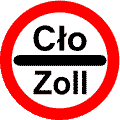
1. Marking P-12 "absolute stop line - stop" indicates the place where the vehicle is to be stopped in connection with vertical signs B-20 or B-32.


2. Marking P-13 "conditional stop line composed of triangles" indicates the place where the vehicle is to be stopped in order to give way as required by vertical sign A-7.
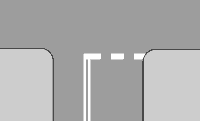
3. Marking P-14 "conditional stop line composed of rectangles" indicates the place where the vehicle is to be stopped:
1) at an intersection on the approaches of roads of equal rank;
2) before a pedestrian crossing;
3) before tram stops without islands;
4) before tram crossings and level crossings;
5) before a cycle crossing;
6) before a cycle box;
7) before a light signal.
3a. The obligation to stop the vehicle at the place referred to in paragraph 3 does not apply to the driver of a bicycle entering a cycle box.


§ 90.

1. Marking P-17 "stop line" designates on the carriageway the stopping place of the vehicles specified in § 51 and means that the prohibition on the stopping of other vehicles at the stop applies along the whole length of the line.


3. Marking P-19 "line designating a parking lane" designates a lane intended for the parking of vehicles along the edge of the carriageway or separates a parking lay-by from it.


5. Marking P-21 "excluded area" means an area of the road onto which entry and stopping are prohibited.
6. The inscription "EV", "CNG", "LNG", "H2" placed inside marking P-18 or P-20 means, respectively, a place intended for parking or a parking space intended for the parking of electric vehicles (EV), of vehicles powered by compressed natural gas (CNG), liquefied natural gas (LNG) or hydrogen (H2).
§ 91.

1. Marking P-22 "BUS" means a traffic lane intended for the traffic of vehicles providing paid passenger transport on regular services.

2. Marking P-23 "bicycle" means a cycle path, a cycle lane or a cycle box, or a part of the carriageway of a one-way road on which bicycle traffic moves in two directions; marking P-23 placed together with marking P-26 means that the road is intended for pedestrians and drivers of bicycles.
2a. A cycle cart may move on the part of the road marked with marking P-23 if the vertical signing of that part of the road indicates such a possibility.
3. Inscriptions or symbols other than those specified in paragraphs 1 and 2 indicating its intended use may be placed on a traffic lane.
§ 92.

Marking P-24 "space for the vehicle of a disabled person" means that the parking space on which the marking is placed is intended for the automotive vehicle of the persons referred to in Art. 8(1) and (2) of the Act.
§ 93.

Marking P-25 "speed hump" means a raised area on the carriageway used in order to slow down the traffic of vehicles.
§ 93a.
Marking P-26 "pedestrians" means a footway; marking P-26 placed together with marking P-23 means that the road is intended for pedestrians and drivers of bicycles.
§ 93b.
Marking P-27 "direction and path of bicycle movement" indicates to the driver of a bicycle the path of the bicycle's movement on the carriageway and specifies the direction of that movement.
§ 94.
The provisions of § 85-87, 89 and 90 apply accordingly to columns of pedestrians, riders and drovers.