Unofficial translation for learning purposes. Only the Polish text published in Dziennik Ustaw is legally binding — open the Polish original. Source: Regulation of 31 July 2002 on road signs and signals (Dz. U. 2019 poz. 2310, as amended).
§ 83.
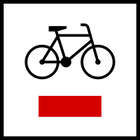
1) R-1 "local cycle route",
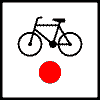
2) R-1a "beginning (end) of a local cycle route",
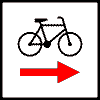
3) R-1b "change of direction of a local cycle route" mean, respectively, the course of the local cycle route.
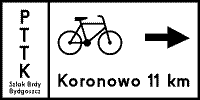
3. Sign R-3 "local cycle route board" indicates the distance to the main localities situated along the local cycle route.
4. Sign R-4 "information about a cycle route" indicates the type of cycle route. A plate placed under sign R-4 informs about an obstruction occurring on the cycle route.
5. In the lower part of sign R-4 a symbol, number or colour marking characterising the cycle route is placed.
1) R-4a "information about the actual course of a cycle route",
2) R-4b "change of direction of a cycle route",
3) R-4c "board-type direction sign of a cycle route",
4) R-4d "arrow-shaped direction sign of a cycle route giving the distance",
5) R-4e "advance direction board of a cycle route" indicate the course and direction of the cycle route.
7. On sign R-4a a graphic illustration of the course of the cycle route in a diagram of the actual road layout is placed, whereby the course of the cycle route is marked with a wider line ending in the shape of an arrow indicating its direction.
8. In the lower part of sign R-4b a symbol, number or colour marking characterising the cycle route is placed. A plate placed under sign R-4b informs about an obstruction occurring on the cycle route. Additional signs for drivers of military vehicles
§ 84.
1. The signs for drivers of military vehicles are:
1) sign W-1 "load class of a one-way bridge";
2) sign W-2 "load class of a two-way bridge";
3) sign W-3 "load class of a one-way bridge for wheeled and tracked vehicles";
4) sign W-4 "load class of a two-way bridge for wheeled vehicles";
5) sign W-5 "load class of a two-way bridge for tracked vehicles";
6) sign W-6 "width of a bridge or crossing facility";
7) sign W-7 "clearance height of the carriageway".
2. The meaning of the signs referred to in paragraph 1 is specified by separate regulations.
§ 108.
1. The person directing traffic gives signals by means of posture and arm movements.
2. A posture in which the person directing traffic is turned sideways to the approaching vehicles means permission to enter the intersection or the section of road beyond the person directing traffic, and for pedestrians - permission to step onto the carriageway.
3. A posture in which the person directing traffic is turned facing or with their back to the approaching vehicles means a prohibition on entering the intersection or the section of road beyond the person directing traffic, and for pedestrians - a prohibition on stepping onto the carriageway.
4. The raising of an arm upwards by the person directing traffic means a forthcoming change of the signal given so far. For road users for whom traffic was closed it means that in a moment a signal will be given permitting entry or stepping onto the carriageway, and for road users for whom traffic was open it means that in a moment a signal will be given prohibiting entry or stepping onto the carriageway.
5. The arm of the person directing traffic extended horizontally, transversely to the direction of travel of the approaching vehicles, means a prohibition on entering the intersection or the section of road beyond the person directing traffic.
§ 109.
1. The signal meaning an order to stop the vehicle is given:
1) in conditions of sufficient visibility - with a vehicle-stopping disc;
2) in conditions of insufficient visibility - with a vehicle-stopping disc with a reflective light or a red light, or with a torch with a red light.
2. The vehicle-stopping disc referred to in paragraph 1 has the shape of a red circle with a white rim.
3. A uniformed police officer, an inspector of the Road Transport Inspectorate, a soldier of the Military Police and a soldier of the military order-keeping bodies may, in conditions of sufficient visibility, give the signal to stop the vehicle with the hand alone.

§ 110.
A yellow board with sign B-20 with a yellow inscription and rim, visible on a school bus, means an order to stop the vehicles travelling on the carriageway on which or beside which the bus has stopped.
§ 111.
1. An audible signal given by a person directing traffic or authorised to control it is a signal warning road users or drawing their attention to other signals or instructions.
2. A police officer, an inspector of the Road Transport Inspectorate or a soldier of the Military Police travelling in an automotive vehicle may, within the scope of their statutory powers, give the driver of a vehicle instructions to:
1) behave in a specified way - by means of amplifying, signalling or light devices;
2) stop - in the case of driving behind the driver to whom the instruction is addressed - by briefly switching on a blue flashing light and an audible signal of variable tone.
3. The provision of paragraph 2 point 1 applies accordingly to a police officer or a soldier of the Military Police moving in an aircraft.
§ 113.
1. An audible signal emitted in the form of a bell at a level crossing warns of an approaching train or other rail vehicle or of the lowering of the barriers (half-barriers).
2. Audible signals emitted in the form of buzzers or sounders or of spoken messages at pedestrian crossings where traffic is directed by light signals inform persons with impaired sight that a green signal is being given for pedestrians.
3. The operation of the vibrating device on the traffic light informs persons with impaired sight and hearing that a green signal is being given for pedestrians.
§ 114.

1) a board with a white background and a black rim and an inscription giving the name of the locality has the same meaning as sign D-42; the provision of § 15(3) applies accordingly;

2) the board referred to in point 1, crossed diagonally with a red line, has the same meaning as sign D-43;

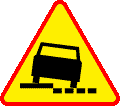
3) sign A-30 with a plate containing the symbol placed on sign A-31 has the same meaning as sign A-31;
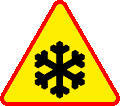
4) sign A-30 with a plate containing the symbol placed on sign A-32 has the same meaning as sign A-32;
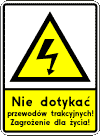
5) a board with a white background placed before a level crossing, bearing the symbol of a skull and the inscription "Attention! Do not touch the wires", has the same meaning as sign G-2.