
Unofficial translation for learning purposes. Only the Polish text published in Dziennik Ustaw is legally binding — open the Polish original. Source: Regulation of 31 July 2002 on road signs and signals (Dz. U. 2019 poz. 2310, as amended).
§ 78.

1) G-1a "indicator post with three bars placed on the right-hand side of the carriageway",

2) G-1b "indicator post with two bars placed on the right-hand side of the carriageway",

3) G-1c "indicator post with one bar placed on the right-hand side of the carriageway",

4) G-1d "indicator post with three bars placed on the left-hand side of the carriageway",

5) G-1e "indicator post with two bars placed on the left-hand side of the carriageway",

6) G-1f "indicator post with one bar placed on the left-hand side of the carriageway" inform of approaching a level crossing.
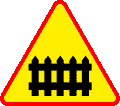
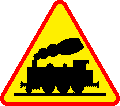
2. The post with three bars is placed beneath sign A-9 or A-10, the post with two bars - at 2/3 of the distance of the warning sign from the crossing, and the post with one bar - at 1/3 of that distance.
3. If, because of local conditions, the warning signs have been placed closer than the distance referred to in § 3(2), the post with two bars is placed beneath the warning sign and the post with one bar at 1/2 of the distance of the warning sign. If the warning sign has been placed in the immediate vicinity of the crossing, only the post with one bar, placed beneath the warning sign, is used.
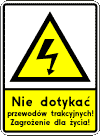
4. Sign G-2 "live overhead line" means that a live overhead contact line is suspended above the level crossing.
5. The signs: mark the place of stopping in connection with the movement of a train or another rail vehicle at a level crossing without barriers or half-barriers; these signs indicate that there are, respectively, one or more tracks at the crossing. Additional signs for tram drivers
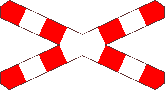
1) G-3 "St Andrew's cross before a single-track level crossing",
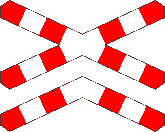
2) G-4 "St Andrew's cross before a multi-track level crossing"
§ 79.
1. Sign AT-1 "light signals" warns of approaching a place where tram traffic is directed by means of three-colour light signals.
2. Sign AT-2 "demand-actuated light signals" warns of approaching an intersection at which the tram actuates a phase reserved for it.
3. Sign AT-3 "steep descent" warns of a significant downward gradient of the tram track, of the value given on the sign.
4. Sign AT-4 "steep ascent" warns of a significant upward gradient of the tram track, of the value given on the sign.
5. Sign AT-5 "conflicting traffic" warns of approaching an intersection with light signals at which a turning tram driver, when leaving the intersection, is obliged to give way to road users travelling straight ahead.
§ 80.
The signs referred to in § 79:
1) are placed on the right-hand side of the track, above the track intended for the given direction of traffic or between the tracks on the poles of the overhead contact line - at a distance of 50 m to 200 m from the dangerous place;
2) oblige tram drivers travelling on the track alongside which they are placed to exercise particular care.
§ 81.
1. Sign BT-1 "speed limit" means a prohibition on a tram driver travelling on the track alongside which it is placed exceeding the speed given on the sign as a number of kilometres per hour.
2. The prohibition expressed by sign BT-1 applies from the place where the sign is placed up to the nearest crossing (junction) of tracks or the place where sign BT-2 "end of speed limit" is placed.
3. Sign BT-3 "point lock" means a prohibition on a tram driver entering under the point-control device until the previous tram has left the points.
4. Sign BT-4 "stop - points operated from one side only" means a prohibition on a tram driver entering the points without stopping before them and an obligation to check that the position of the switch blade is correct.
§ 82.
The signs referred to in § 81 are placed above the track or on the right-hand side of the track intended for the given direction of traffic. Additional signs for cycle routes