
Unofficial translation for learning purposes. Only the Polish text published in Dziennik Ustaw is legally binding — open the Polish original. Source: Regulation of 31 July 2002 on road signs and signals (Dz. U. 2019 poz. 2310, as amended).
§ 35.
1. The signs: oblige the driver to travel in the direction indicated by the arrows; these signs may be placed on the extension of the axis of the road (carriageway) or on the carriageway itself.

1) C-1 "compulsory right turn before the sign",

2) C-2 "compulsory right turn beyond the sign",

3) C-3 "compulsory left turn before the sign",

4) C-4 "compulsory left turn beyond the sign",

5) C-5 "compulsory straight ahead",

6) C-6 "compulsory straight ahead or right turn",

7) C-7 "compulsory straight ahead or left turn",

8) C-8 "compulsory right or left turn",

9) C-9 "compulsory passing to the right of the sign",

10) C-10 "compulsory passing to the left of the sign",

11) C-11 "compulsory passing to the right or to the left of the sign"
2. The signs referred to in paragraph 1 apply at the nearest intersection or at the place where it is possible to change the direction of travel.
3. A plate with the inscription "Does not apply to" placed beneath signs C-1 to C-10, together with the symbol of a vehicle or an expression specifying a vehicle, indicates that the mandatory instruction does not apply to the vehicle specified on the plate.
§ 36.

1. Sign C-12 "roundabout" means that at the intersection traffic circulates around an island or a square in the direction shown on the sign.
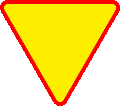
2. Sign C-12 occurring together with sign A-7 means that a driver already on the intersection has right of way over a driver entering (or a pedestrian stepping onto) that intersection.
§ 37.

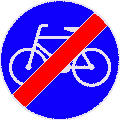
1. Sign C-13 "cycle path" means a road intended for drivers of bicycles, who are obliged to use that road if it is designated for the direction in which they are travelling or intend to turn.
2. The mandatory instruction expressed by sign C-13 applies until cancelled or up to:

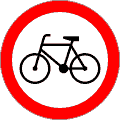
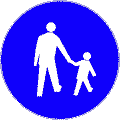
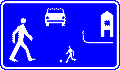
1) the place where sign B-1, B-9, C-16 or D-40 is placed;
2) the nearest intersection.
§ 38.

1. Sign C-14 "minimum speed" means that the driver, while observing the speed limits resulting from specific provisions, is obliged to travel at a speed not lower than the speed given on the sign as a number of kilometres per hour, unless traffic conditions or traffic safety require a reduction of speed.

2. Sign C-15 "end of minimum speed" marks the place where the minimum speed specified by sign C-14 ceases to apply.
§ 39.
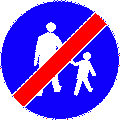
1. Sign C-16 "footway" means a road or a part of it intended for pedestrians, who are obliged to use it.

§ 40.
1. The symbols of signs C-13 and C-16 placed on a single sign face and separated by a horizontal line mean that the road is intended for pedestrians and for drivers of bicycles. Drivers of bicycles are obliged to use a road so marked if it is designated for the direction in which they are travelling or intend to turn. Pedestrian and bicycle traffic takes place over the entire surface of the road so marked.
2. The symbols of signs C-13 and C-16 placed on a single sign face and separated by a vertical line mean a cycle path and a footway situated next to each other, on the sides respectively shown on the sign. Drivers of bicycles are obliged to use a road so marked if it is designated for the direction in which they are travelling or intend to turn.
3. The provisions of paragraphs 1 and 2, § 37(2) and (3) and § 39(1a) and (2) apply accordingly to marking the end of a road for pedestrians and drivers of bicycles and the end of a cycle path and a footway situated next to each other, whereby sign C-13/C-16 is also cancelled by signs C-13 or C-16.
§ 41.
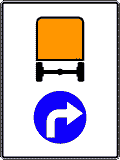
Sign C-17 "mandatory direction of travel for vehicles carrying dangerous goods" means the binding direction of travel at the intersection, indicated by signs C-2, C-4, C-5, C-6, C-7 or C-8, for vehicles carrying dangerous goods specified in § 19(2). A plate T-31 placed beneath the sign, or a plate with an appropriate inscription, indicates that the mandatory direction of travel applies only to vehicles carrying specified classes or groups of dangerous goods or to a specified manner of carrying those goods.
§ 42.

1. Sign C-18 "snow chains compulsory" means that on the road on which the sign has been placed, the driver of a motor vehicle is obliged to use snow chains on at least two driving wheels; a plate placed beneath the sign, referred to in § 23(2), means that the sign applies to the vehicles specified on the plate.
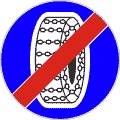
2. Sign C-19 "end of compulsory use of snow chains" marks the place where the mandatory instruction specified by sign C-18 ceases to apply. Information signs